What is an ERV? (And Why Air Purification Needs It)
An Energy Recovery Ventilator (ERV) is a mechanical fresh-air system that continuously exchanges stale indoor air for fresh outdoor air. Unlike standard exhaust fans that simply dump your climate-controlled air outside, an ERV utilizes a specialized static-plate core to recycle the heating or cooling energy already inside your building. This continuous air exchange provides a constant supply of fresh oxygen while keeping your utility bills under control.
The Technology:
How a Static-Plate Core works
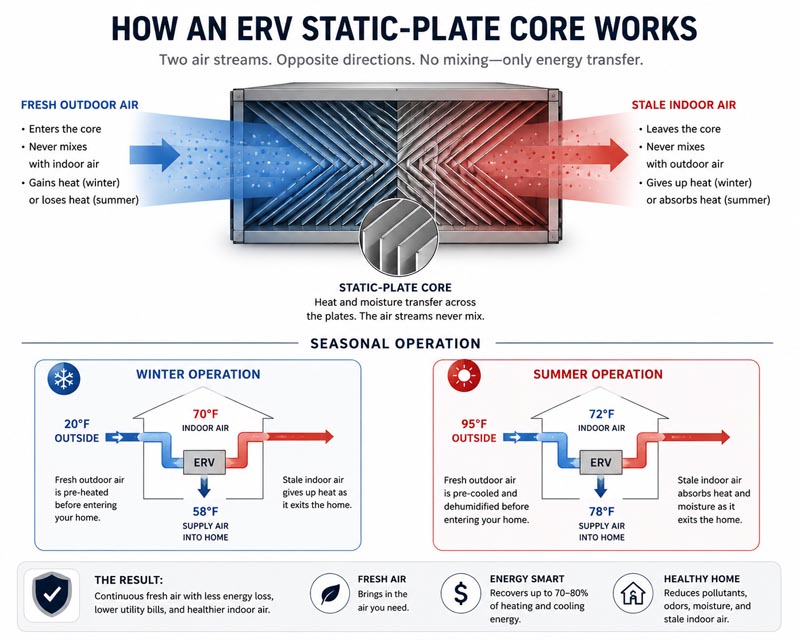
To understand an ERV, think of it as a highly efficient heat exchanger for your building’s lungs. The machine hooks directly into your structural ventilation and utilizes two continuous fan streams moving in opposite directions.
- The Thermal Cross-Over: As stale, conditioned indoor air is pushed out of the building, it passes through microscopic pathways directly adjacent to incoming outdoor air. The two air streams never actually mix, but their thermal energy does.
- Winter Operation: The heat from your warm, outgoing indoor air is transferred to the freezing incoming outdoor air, pre-heating it before it ever hits your furnace.
- Summer Operation: The cooling and dehumidification energy of your air-conditioned indoor air is transferred to the hot, sticky incoming outdoor air, dropping its temperature and humidity before it enters the room.
💡 The Indoor Air Quality Equation
Ventilation (ERV) replaces the air you breathe over time.
Purification (LakeAir) scrubs the immediate air mass you are standing in.
True purity requires both systems working as a team.
The Mass Balance Principle: Ventilation vs. Purification
When dealing with heavy-odor or high-contaminant spaces like cigar lounges and home smoking rooms, there is a common myth that ventilation and air purification are the same thing. They are completely different mechanisms that must work in tandem.
The ERV Handles the Molecular Envelope (Mass Balance)
Air is a finite fluid volume within a building. If you exhaust a specific volume of air, an equal volume must enter. An ERV manages this molecular exchange. It brings in fresh oxygen and flushes out gaseous contaminants that physical filters cannot trap—such as carbon dioxide (CO₂) buildup from respiration or carbon monoxide (CO) from combustion. However, because it moves air slowly to maximize heat exchange efficiency (typically 1–2 air changes per hour), an ERV cannot clear smoke clouds or dense odors on its own.
The LakeAir System Handles Localized Particulate Density
Heavy airborne particulates, ash, tar, and volatile organic compounds (VOCs) require rapid, high-volume scrubbing (typically 10–15 air changes per hour). This is where internal recirculating filtration excels. A heavy-duty smoke eater continuously pulls the immediate air mass through deep-bed carbon and HEPA media, trapping the physical contaminants exactly where they are generated.
Advanced Containment:
The "Unbalanced" Isolation Strategy
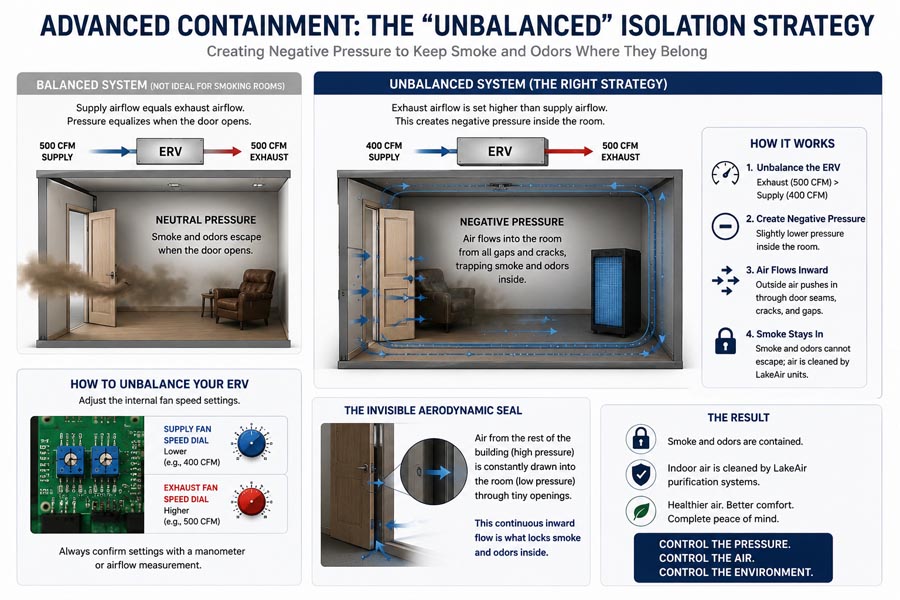
n a standard residential property, an HVAC contractor will calibrate an ERV to be perfectly balanced, meaning the volume of incoming fresh air exactly matches the volume of outgoing exhaust air. In a designated smoking room or commercial lounge, a balanced system is an engineering flaw.
Every time a user opens the door to a balanced room, the air pressure equalizes instantly, allowing a cloud of smoke and odor to drift into neighboring hallways or living quarters.
Creating an Invisible Aerodynamic Seal
To trap odors completely, you must control the directional path of the air by intentionally unbalancing the ERV. By accessing the unit’s internal potentiometers or fan speed dials, the exhaust airflow is configured to run slightly higher than the supply airflow.
This minor calibration difference drops the static pressure inside the room envelope, creating a negative pressure pocket. Because air naturally flows from high pressure to low pressure, air from the rest of the building will continuously push inward through door seams and cracks. This creates an invisible aerodynamic boundary that locks smoke and odors inside the room, where your heavy-duty internal LakeAir units can systematically scrub the air mass clean.