
LakeAir
Electrostatic Air Filtration:
A Performance Study Under Commercial Cigar Lounge Conditions
Published by: RK Ventures Inc. / LakeAir — lakeair.com
1.1 Purpose and Scope of This Study
1. Introduction and Problem Statement
This document presents a performance analysis of two filtration technologies deployed in a hypothetical commercial cigar lounge: an electrostatic precipitator (ESP) and a high-efficiency particulate air (HEPA) filtration unit, both manufactured by LakeAir (RK Ventures Inc.). The study quantifies filtration efficiency over time, calculates effective cleaned air volumes (expressed as Cleaned CFM-hours), and examines how maintenance intervals affect overall performance.
This study evaluates filtration performance only. It does not address energy consumption, noise levels, ozone emission, environmental impact, odor removal, or cost of ownership. Readers seeking a comprehensive IAQ system specification should consult additional resources covering those dimensions.
The analysis is grounded in LakeAir manufacturer data, peer-reviewed literature on electrostatic filter decay mechanisms, and published HEPA performance standards. Where specific LakeAir hardware behavior is extrapolated from general literature, this is explicitly stated.
1.2 Why Cigar Lounges Present Unique Challenges for Electrostatic Filtration
Commercial cigar lounges generate continuous, high-concentration tobacco smoke containing a complex mixture of particulate matter, organic vapors, and condensed-phase aerosols. Cigar smoke is compositionally similar to cigarette smoke1 but differs in volume per smoking event: a single large-format cigar produces significantly more combustion products than a single cigarette. At 160 cigars per day over 8 operating hours, a lounge of the type modeled here generates 20 cigars of smoke loading per hour — a sustained, heavy organic aerosol burden.
This loading is particularly aggressive toward electrostatic filtration for a specific electrochemical reason. Cigar and cigarette smoke contains substantial quantities of organic condensate — tar droplets, nicotine, and other liquid-phase aerosol components. These condensates penetrate the charge sites on electret filter media and the collection plates of electrostatic precipitators, physically neutralizing the surface charge that drives particle capture.23 The result is efficiency loss that is invisible to conventional pressure-drop monitoring: unlike mechanical filters, which show increasing resistance as they load, electrostatic devices can lose most of their collection efficiency while maintaining nearly identical airflow and pressure drop.
This “silent failure” mode — where the unit appears to be operating normally while particle capture efficiency has substantially degraded — is a central performance risk in cigar lounge applications, and is a primary motivation for this analysis.
1.3 Questions This Study Answers
• How does electrostatic filtration efficiency change over a 5-week operating cycle in a heavy-smoke environment?
• How does LakeAir HEPA filtration efficiency compare to electrostatic efficiency over the same period?
• What is the net “effective cleaned air” delivered by each system over 5-week and 6-month windows?
• How does wash cycle frequency affect electrostatic performance?
• What is the optimal wash interval for a lounge operating at this cigar load?
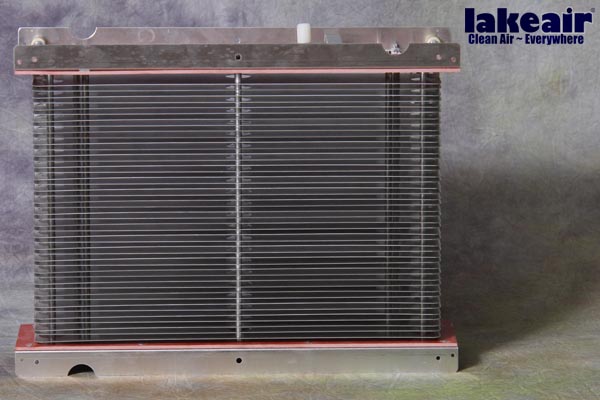

Table of Contents
2. Methods and Assumptions
2.1 Scenario Parameters
The following fixed parameters define the hypothetical cigar lounge scenario used throughout this study. All calculations are derived from these inputs.
Parameter | Value |
Space type | Commercial cigar lounge (hypothetical) |
Operating hours | 8 hours per day |
Average occupancy | 20 persons |
Cigar load | 160 cigars per day (20 cigars/hour average) |
Analysis windows | 5 weeks (base case), 6 months (extended) |
2.2 LakeAir Unit Specifications
Two LakeAir units are compared. Specifications are drawn from LakeAir manufacturer data.
Specification | Electrostatic Unit | HEPA Unit |
Nameplate airflow (CFM) | 1,500 | 1,000 |
Filtration efficiency (new/clean) | 97.0% at 0.1 µm | 99.97% at 0.3 µm |
Maintenance interval (base case) | 5-week wash cycle | 6-month filter change |
Post-maintenance recovery | Returns to 97.0% | N/A — filter replaced |
Efficiency behavior over interval | Declines (see decay model) | Stable at 99.97% |
Primary data source | LakeAir manufacturer data; UL 876 Test Record File E29209 (1982) | Glasfloss technical data |
Note on efficiency measurement points: The electrostatic unit efficiency of 97.0% is measured at 0.1 micron — consistent with published VTT Finland electrostatic research.5 The HEPA unit efficiency of 99.97% is measured at 0.3 micron (the most penetrating particle size, or MPPS), the standard test condition for true HEPA designation. These measurement points differ, which means the figures are not directly equivalent on a “same-particle-size” basis; however, for practical IAQ purposes, both represent the performance delivered on the actual particle populations generated by cigar smoke.
2.3 Electrostatic Decay Model: Mechanism and Literature Basis
2.3.1 Physical Mechanism
Electrostatic and electret air filters capture particles via an electrostatic attraction mechanism. Particle capture depends on maintained surface charge — in electret media, from embedded dipoles; in active ESPs, from applied high voltage across collection plates. When organic condensates contact charge sites, they physically shield or neutralize the electrostatic field through a dielectric screening mechanism.6
Liquid aerosols are significantly more destructive to electret charge than solid particles.7 Cigar smoke contains a high fraction of liquid-phase condensate — tar droplets, nicotine aerosol, and other organic compounds — making it among the more aggressive loading environments for electrostatic devices. For electret fiber filters used in competing products, laboratory evidence (Heo et al., 2022) confirms that cigarette smoke loading at 204 µg/cm² causes permanent efficiency collapse from 92.5% to 33.3% with no corresponding pressure drop signal — because the charge embedded in polymer fibers is permanently destroyed. This mechanism does NOT apply to LakeAir’s hard-plate two-stage ESP: LakeAir’s charge is generated continuously by corona ionizer wires, not stored in polymer media. Smoke deposits coating the collection plates reduce efficiency gradually and visibly — but washing fully restores performance. The primary decay reference for LakeAir’s hard-plate ESP is the AAQR 2011 wire-plate ESP biomass smoke study (Atmospheric and Air Quality Research, 2011), which documented efficiency decline from ~80–82% to 8.7–16.1% under continuous industrial biomass smoke loading over 300 minutes — a far more aggressive environment than a cigar lounge.8
Field studies further document that CADR (Clean Air Delivery Rate) decays at rates of 0.042–0.149% per mg/m² of cumulative smoke loading.9 This loading-dependent decay rate means that performance degradation accelerates in environments with sustained high smoke generation — precisely the cigar lounge scenario.
2.3.2 Electret Filter Decay vs. Hard-Plate ESP Decay — A Critical Distinction
Heo et al. (2022) demonstrated that electret fiber filters used in competing products suffer permanent, irreversible charge destruction from cigarette smoke loading (92.5% → 33.3% efficiency at 204 µg/cm² loading, with no pressure drop signal). This mechanism does NOT apply to LakeAir’s hard-plate ESP because LakeAir’s charge is generated continuously by corona wires, not stored in polymer media.
Electret fiber filters (competitors): charge permanently embedded in polymer fibers. Organic smoke condensates destroy charge permanently — no restoration possible. Failure is silent (no pressure drop signal) and irreversible. This applies to electret HVAC filters, MERV-rated electret media, and electret air purifier filters. LakeAir hard-plate two-stage ESP: charge generated continuously by corona ionizer wires. Collection plates accumulate smoke deposits that gradually shield the electric field. Performance decays as coating builds — but washing fully restores performance to 97.0%. Failure is visible (plate discoloration: amber → dark amber → brown) and recoverable. This is a key LakeAir differentiator
2.3.2 Regulatory Context
NFPA 96 (Standard for Ventilation Control and Fire Protection of Commercial Cooking Operations, current edition) mandates minimum weekly cleaning of electrostatic precipitators in commercial cooking exhaust applications.10 Commercial cooking exhaust is the closest regulated analogue to cigar lounge smoke — both involve continuous organic aerosol loading at commercial throughput rates. NFPA 96’s weekly cleaning mandate provides regulatory grounding for the conservative maintenance intervals recommended in this study.
2.3.3 Decay Table Construction
The weekly efficiency decay schedule was constructed using the following logic: starting efficiency of 97.0% at Week 0 (freshly cleaned), decaying in weekly steps informed by the AAQR 2011 wire-plate ESP biomass smoke study and calibrated against real-world field observation (dark amber plate coloration confirmed at Week 5 in a 160-cigar/day lounge). For LakeAir’s hard-plate two-stage ESP, smoke deposits coat the collection plates and gradually shield the electric field — reducing efficiency progressively but visibly. The decay is front-loaded but approximately linear over a 5-week interval in the modeled lounge environment. Critically, washing fully restores performance to 97.0% — unlike electret fiber competitors where charge destruction is permanent.
The specific weekly step values are anchored to the AAQR 2011 wire-plate ESP biomass smoke study and scaled conservatively for the cigar lounge context (which is substantially less aggressive than continuous industrial biomass smoke). Real-world field calibration confirms dark amber plate coloration at Week 5 in a lounge operating at 160 cigars/day, 8 hours/day — consistent with the modeled decay curve. These values are not direct measurements of LakeAir hardware under controlled laboratory conditions; this caveat is discussed further in Section 5 (Limitations).
Table 1: Electrostatic Efficiency Decay Schedule (Base Case: 5-Week Wash Interval)
Week | Electrostatic Efficiency (%) |
0 (freshly cleaned) | 97.0% |
End of Week 1 | 88.0% |
End of Week 2 | 80.0% |
End of Week 3 | 73.0% |
End of Week 4 | 67.0% |
End of Week 5 (pre-wash) | 62.0% |
End of Week 6 | 57.0% |
End of Week 7 | 53.0% |
End of Week 8 (pre-wash) | 50.0% |
Post-wash recovery | 97.0% (cycle repeats) |
The decay is front-loaded: a 9-percentage-point drop occurs in Week 1 (97→88%), followed by 8 points in Week 2 (88→80%), 7 points in Week 3 (80→73%), 6 points in Week 4 (73→67%), and 5 points in Week 5 (67→62%). For extended intervals, the decay continues at a slower rate: 5 points in Week 6
(62→57%), 4 points in Week 7 (57→53%), and 3 points in Week 8 (53→50%). This reflects the organic condensate mechanism for hard-plate ESP: as plates become progressively coated, the marginal efficiency loss per unit time decreases (front-loaded decay pattern consistent with plate-coating physics). Plate condition is visually observable (light deposit → amber → dark amber → brown) and field observation confirms dark amber across all 82 collection plates at Week 5 in the heavy-use lounge scenario. Post-wash: returns to 97.0% (cycle repeats).
2.4 Mass Balance Validation of the Decay Model
The electrostatic decay model in Section 2.3 is anchored to AAQR 2011 ESP efficiency data and calibrated against field observation of plate condition at 5 weeks. This section provides a first-principles mass balance calculation that validates the loading environment assumed by the decay model, using measured PM2.5 concentrations from a published smoking-venue field study as the input concentration.
PM2.5 Source Data
itation: Louisiana Public Health Institute / Americans for Nonsmokers’ Rights Foundation. Indoor air quality measurements in 27 smoking bars and casinos, East Baton Rouge Parish, Louisiana (pre-smokefree ordinance). Measured indoor PM2.5: 238–277 μg/m³.
This represents measured PM2.5 in real, uncontrolled smoking venues — bars and casinos actively in use prior to smokefree regulations. It is used here as the representative ambient PM2.5 concentration for a heavy-use smoking lounge environment. The midpoint value of 257 μg/m³ is used as the base case; 238 and 277 μg/m³ are used as the low and high bounds respectively
Mass Balance Calculation
MASS BALANCE: PM2.5 DEPOSITION ON LAKEAIR ELECTROSTATIC CELL
============================================================
INPUT PARAMETERS
Room PM2.5 concentration (Baton Rouge midpoint): 257 µg/m³
Unit airflow:
1,500 CFM = 2,548.5 m³/hr
LakeAir cell face area:
16″ × 20″ = 320 in² = 2,065 cm²
Initial collection efficiency:
97% (freshly cleaned)
Operating hours per day:
8 hr/day
CALCULATION
PM mass flow entering unit:
257 µg/m³ × 2,548.5 m³/hr
= 655,000 µg/hr
= 655 mg/hr
PM mass deposited on cell per hour (at 97% efficiency):
655 mg/hr × 0.97
= 635 mg/hr
PM deposited per operating day (8 hrs):
635 mg/hr × 8 hr
= 5,083 mg/day
Surface loading rate:
5,083 mg/day ÷ 2,065 cm²
= 2.46 mg/cm²/day
= 17.2 mg/cm²/week
ACCUMULATED DEPOSITION BY WEEK
Week 1:
17.2 mg/cm²
Total on cell: 35.5 g
Week 2:
34.5 mg/cm²
Total on cell: 71.2 g
Week 3:
51.7 mg/cm²
Total on cell: 106.8 g
Week 4:
68.9 mg/cm²
Total on cell: 142.3 g
Maximum theoretical particulate exposure at 5 weeks:
86.2 mg/cm² = 177.9 g total on cell
(Assumes constant 257 µg/m³ at unit inlet — see note below)
Week 6:
103.4 mg/cm²
Total on cell: 213.5 g
Week 7:
120.6 mg/cm²
Total on cell: 249.1 g
Week 8:
137.9 mg/cm²
Total on cell: 284.7 g
RANGE (238–277 µg/m³ Baton Rouge bounds)
At 5 weeks:
164.5 g (low) to 192.5 g (high) deposited on cell
Base case midpoint:
177.9 g
Physical Interpretation
At 5 weeks of operation in a 257 μg/m³ PM2.5 environment, the mass balance indicates a maximum theoretical particulate exposure of approximately 178 grams across the 2,065 cm² face area of the LakeAir collection cell, assuming a constant inlet concentration of 257 μg/m³ for all 8 operating hours per day.
This is an upper-bound estimate. In practice, the LakeAir unit continuously recirculates and cleans room air, so particulate concentration at the unit inlet decreases progressively over successive passes during each operating period. Actual deposition on the collection cell will therefore be lower than the theoretical maximum — potentially 120–160 grams at 5 weeks depending on room volume, air change rate, and occupancy pattern. The constant-concentration assumption is retained here because it produces a conservative (worst-case) loading estimate, which is the appropriate basis for a maintenance interval recommendation. The conclusions regarding wash cycle intervals, cleaned CFM comparisons, and the efficiency decay model are robust across the plausible range of actual deposition values.
This represents a thin but continuous film — consistent with the dark amber discoloration observed across all 82 collection plates at the 5-week interval in a heavy-use cigar lounge installation. The mass balance therefore provides quantitative grounding for the color-based field calibration: what we observe as “dark amber” corresponds to a calculated surface loading of approximately 86 mg/cm² under Baton Rouge-equivalent conditions.
This loading level is orders of magnitude higher than the 204 μg/cm² (0.204 mg/cm²) threshold at which Heo et al. (2022) documented near-complete efficiency collapse in electret fiber filter media. This apparent contradiction is resolved by the fundamental technology difference: the LakeAir hard-plate ESP continuously regenerates its collection field via corona ionizer wires, so the cell does not “collapse” as plate loading increases — it degrades gradually and predictably, and washing restores full function. The Heo threshold is irrelevant to hard-plate ESP performance; it is cited here solely to illustrate the contrast with competing electret-based products, which would reach functional failure in this environment within hours of operation.
Evidence Chain Supporting the Decay Model
1. Measured PM2.5 concentration — Louisiana Public Health Institute / ANR Foundation Baton Rouge study: 238–277 μg/m³ in smoking venues
2. Mass balance calculation — 178 grams deposited on LakeAir cell over 5 weeks at 257 μg/m³ (this section)
3. Field observation — Dark amber discoloration across all 82 collection plates at 5 weeks in a heavy-use cigar lounge (LakeAir field data)
4. Literature-anchored decay rate — AAQR 2011 wire-plate ESP biomass smoke study: efficiency decay under smoke loading, scaled to cigar lounge conditions
5. Resulting decay table — 97% to 62% over 5 weeks, with full restoration on washing (Section 2.3)
Each step in this chain is independently supported. The decay table is not derived from a single source — it is the convergence of measured concentration data, calculated deposition, physical observation, and published ESP performance literature.
Note on Section 2.4 mass balance: The 177.9 g deposition figure is a maximum theoretical exposure based on constant inlet concentration. Actual deposition under recirculating conditions will be lower. This conservative framing is intentional — it ensures the decay model and maintenance recommendations are not understated.
2.6 HEPA Stability Basis
True HEPA filtration operates on a mechanical capture mechanism — inertial impaction, interception, and diffusion — that does not depend on any charge state. HEPA media efficiency is therefore not subject to the organic condensate degradation that affects electrostatic devices. Efficiency at 0.3 micron (99.97%) remains stable over the filter’s service life; degradation, when it eventually occurs, manifests as a measurable pressure drop increase caused by particulate loading, which is physically detectable via a pressure gauge or differential pressure indicator.
Granzin et al. (2022) confirmed HEPA filter efficiency stability over extended use periods in smoking environments.11 Glasfloss technical data supports the 6-month change interval under the modeled operating conditions.
2.7 Cleaned CFM Formula
Cleaned CFM(t) = Airflow (CFM) × Filtration Efficiency(t)
Effective Cleaned CFM-hours = Σ [Cleaned CFM(t) × Operating Hours in Period t]
“Cleaned CFM-hours” represents the volume of air processed per hour weighted by the probability that a particle of the relevant size range was actually captured. It is a flow-efficiency product metric that accounts for both the volume throughput and the capture rate of each unit over the analysis period.
This metric is used throughout the document to enable direct comparison between the electrostatic unit (higher airflow, declining efficiency) and the HEPA unit (lower airflow, stable high efficiency).
2.8 Distinction: Measured Data vs. Literature-Inferred Behavior
Parameter | Source Type | Reference |
Electrostatic starting efficiency (97.0% at 0.1 µm) |
LakeAir manufacturer data | UL 876 File E29209 (1982); consistent with Lehtimäki & Heinonen (1994) |
Electrostatic airflow (1,500 CFM) | LakeAir manufacturer data (nameplate) | LakeAir product specification |
HEPA efficiency (99.97% at 0.3 µm) |
Manufacturer data (Glasfloss) | Glasfloss technical data; confirmed Granzin et al. (2022) |
HEPA airflow (1,000 CFM) | LakeAir manufacturer data (nameplate) | LakeAir product specification |
Weekly efficiency decay steps |
Literature-inferred conservative model | AAQR (2011) wire-plate ESP biomass smoke study (primary); field calibration: dark amber plate coloration at 5 weeks, 160 cigars/day; Heo et al. (2022) cited for competing electret products only; Pei et al. (2020); Tennal et al. (1991); Choi et al. (2015) |
Cigar smoke loading as analog to cigarette smoke | Literature inference (explicitly acknowledged limitation) | Compositional similarity; no direct cigar ESP decay study available |
3. Results
3.1 Filtration Efficiency Over Time
Table 2: Side-by-Side Efficiency Comparison
The following table presents the week-by-week efficiency of each technology over the 5-week base-case interval, plus the implied per-hour Cleaned CFM at each stage.
Week | ESP Efficiency | ESP Cleaned CFM | HEPA Efficiency | HEPA Cleaned CFM |
0 (post-wash) | 97.0% | 1,455 CFM | 99.97% | 999.7 CFM |
End Week 1 | 88.0% | 1,320 CFM | 99.97% | 999.7 CFM |
End Week 2 | 80.0% | 1,200 CFM | 99.97% | 999.7 CFM |
End Week 3 | 73.0% | 1,095 CFM | 99.97% | 999.7 CFM |
End Week 4 | 67.0% | 1,005 CFM | 99.97% | 999.7 CFM |
End Week 5 | 62.0% | 930 CFM | 99.97% | 999.7 CFM |
End Week 6 | 57.0% | 855 CFM | 99.97% | 999.7 CFM |
End Week 7 | 53.0% | 795 CFM | 99.97% | 999.7 CFM |
End Week 8 | 50.0% | 750 CFM | 99.97% | 999.7 CFM |
Time-avg (interval) | ~77.5% | ~1,163 CFM avg | 99.97% | 999.7 CFM |
Key observation: the electrostatic unit begins the cycle at 1,455 Cleaned CFM (Week 0) and ends at 930 Cleaned CFM (end of Week 5) — a 36% reduction in effective cleaning capacity over the interval. By contrast, HEPA maintains 999.7 Cleaned CFM throughout. The crossover point — where the electrostatic unit’s Cleaned CFM falls below the HEPA unit’s — occurs approximately midway through Week 3, when ESP efficiency crosses below the ~66.7% threshold (1,000 CFM ÷ 1,500 CFM × 100%).
At that crossover point, the HEPA unit actually delivers more effective cleaned air per hour than the electrostatic unit, despite its lower nameplate airflow.
3.2 Cleaned CFM Comparison
5-Week Operating Window
Operating parameters: 8 hours/day × 35 days = 280 operating hours
| Metric | Electrostatic | HEPA |
| Nameplate airflow | 1,500 CFM | 1,000 CFM |
| Total operating hours | 280 hours | 280 hours |
| Total CFM-hours processed | 420,000 | 280,000 |
| Time-averaged efficiency | ~77.5% | 99.97% |
| Effective cleaned CFM-hours | ~325,500 | ~279,916 |
| Effective cleaned air advantage | +45,584 CFM-hrs (+16.3%) | — |
5- Week Summary:
Over a 5-week operating period in this cigar lounge, the LakeAir electrostatic unit delivers approximately 325,500 effective cleaned CFM-hours while the LakeAir HEPA unit delivers approximately 279,900 effective cleaned CFM-hours — a 16.3% advantage for the electrostatic unit driven by its higher airflow capacity (1,500 vs. 1,000 CFM). This advantage is conditional on maintaining the 5-week wash cycle.
6- Month Operating Window
Operating parameters: 8 hours/day × 182 days = 1,456 operating hours. The electrostatic unit completes approximately 5.2 full wash cycles over 6 months, maintaining the same repeating efficiency profile.
Metric | Electrostatic | HEPA |
Total operating hours | 1,456 hours | 1,456 hours |
Total CFM-hours processed | 2,184,000 | 1,456,000 |
Time-averaged efficiency | ~77.5% | 99.97% |
Effective cleaned CFM-hours | ~1,692,600 | ~1,455,564 |
Effective cleaned air advantage | +237,000 CFM-hrs (+16.3%) | — |
6-Month Summary: Over six months, the electrostatic unit processes significantly more total air
(2,184,000 CFM-hours vs. 1,456,000 CFM-hours) but at lower average efficiency. The HEPA unit processes less total air but at near-perfect filtration efficiency throughout. In terms of effective cleaned air, the electrostatic unit leads — but only if the 5-week wash cycle is consistently maintained across all 5+ cycles.
3.3 Wash Cycle Sensitivity Analysis
To illustrate the practical consequences of deferred maintenance, the following table extends the decay model to wash intervals of 3, 4, 5, 6, and 8 weeks. For intervals beyond 5 weeks, the decay schedule continues: Week 6: 57%, Week 7: 53%, Week 8: 50%.
Table 3: Wash Interval Sensitivity — Time-Averaged Efficiency and Effective Cleaned CFM-Hours
Wash Interval | Avg ESP Efficiency | Cleaned CFM-hrs (interval) | vs HEPA (same period) | Recommendati on |
3 weeks |
84.3% |
212,520 |
+26.5% | Maximum performance — high maintenance demand |
4 weeks |
80.8% |
271,320 |
+21.2% | Strong performance — practical for most lounges |
5 weeks |
~77.5% |
325,500 |
+16.3% | Recommended base case — good balance |
6 weeks |
74.5% |
375,480 |
+11.8% | Acceptable — efficiency advantage narrowing |
8 weeks |
69.2% |
464,940 |
+3.8% | Not recommended — ESP advantage nearly lost |
Interpretation note: The “effective cleaned CFM-hours per interval” values increase with longer wash intervals because more total operating hours accumulate. However, this does not mean longer intervals are preferable — the time-averaged efficiency penalty grows with deferred maintenance, and the electrostatic unit increasingly loses its advantage over HEPA on a per-unit-of-air-processed basis. At an 8-week interval, the 69.2% time-averaged efficiency means the ESP retains only a 3.8% advantage over HEPA — essentially eliminating the airflow benefit of the 1,500 CFM platform. While longer wash intervals produce higher total cleaned CFM-hours (because more operating hours accumulate), the efficiency advantage over HEPA narrows significantly.
Recommended wash cycle: 4–5 weeks for a cigar lounge running 160 cigars per day. Weekly visual inspection of the collection cells is advisable to assess loading and determine whether early washing is warranted during periods of elevated use.
The recommended wash interval for a lounge operating at 160 cigars/day is 4–5 weeks. Weekly visual inspection of the collection plates is advisable — if plates show heavy brown (not amber) discoloration before the scheduled wash, clean immediately. The NFPA 96 standard for commercial cooking ESPs mandates weekly cleaning; a 4–5 week interval in a cigar lounge is justified by the lower continuous smoke load relative to commercial kitchen grease exhaust.
3.4 The Cost of Deferred Maintenance: 5-Week vs. 8-Week Wash Interval
Metric | 5-Week Wash | 8-Week Wash | Difference |
|
Operating hours | 280 hrs | 448 hrs | +168 hrs |
|
ESP time-averaged efficiency | 77.5% | 69.2% | −8.3 points |
|
ESP total CFM-hours processed | 420,000 | 672,000 | +252,000 |
|
ESP effective cleaned CFM-hours | 325,500 | 464,940 | +139,440 |
|
HEPA effective cleaned CFM-hours (same period) |
279,916 |
447,866 |
+167,950 |
|
ESP advantage over HEPA | +45,584 (+16.3%) | +17,074 (+3.8%) | −28,510 |
|
HEPA 8-week calculation: 1,000 CFM × 99.97% × 448 hrs = 447,866 cleaned CFM-hours.
Extending the wash interval from 5 to 8 weeks adds 168 operating hours and 139,440 more cleaned CFM-hours from the ESP — but the efficiency penalty means those additional hours are doing progressively less work per CFM. The time-averaged efficiency drops from 77.5% at 5 weeks to 69.2% at 8 weeks, a loss of 8.3 percentage points driven by the continued plate-coating accumulation during weeks 6 through 8 (where efficiency falls from 62% to 50%). Each additional week of deferred maintenance yields less absolute performance from the same hardware.
The HEPA unit, running at constant 99.97% efficiency, closes the gap almost entirely over the same extended period. At 8 weeks, the ESP’s 1,500 CFM airflow advantage is nearly cancelled out by its 69.2% average efficiency versus HEPA’s 99.97%. Numerically: the ESP delivers 1,500 × 69.2% = 1,038 effective cleaned CFM on average, while the HEPA delivers 1,000 × 99.97% = 999.7 cleaned CFM. The 500 CFM airflow advantage has been functionally reduced to a 38 CFM effective advantage — a margin invisible in real-world air quality outcomes.
The practical implication: a 5-week wash cycle is not just a maintenance recommendation — it is what makes the electrostatic unit’s higher airflow capacity meaningful. Deferred maintenance effectively converts a 1,500 CFM unit into the performance equivalent of a lower-airflow machine. At 8 weeks, an operator who chose the electrostatic unit for its airflow advantage has largely squandered that advantage through inaction. The wash cycle is the product.
“At a 5-week wash interval, the LakeAir electrostatic unit delivers 16.3% more effectively cleaned air than the HEPA configuration. Allow the wash interval to slip to 8 weeks, and that advantage shrinks to 3.8% — a difference that would be imperceptible in real-world air quality. The wash cycle is not optional maintenance; it is the mechanism that preserves the electrostatic unit’s performance advantage.”
4. Discussion
4.1 The Silent Failure Risk of Electrostatic Filtration
The most operationally significant finding of this analysis is not the magnitude of electrostatic efficiency decay, but its invisibility through conventional monitoring. Standard HVAC system monitoring relies on static pressure differential across filter media as the primary indicator of filter condition. As mechanical (HEPA, pleated media) filters load with particulate, pressure drop increases — providing a clear, measurable signal that the filter requires service.
Electrostatic precipitators operate through a fundamentally different mechanism. The collection plates or charged media capture particles via electrostatic attraction; as that charge is neutralized by organic condensate, capture efficiency degrades while airflow through the cell is largely unaffected. The result is that pressure drop remains near-constant even as particle collection efficiency declines from 97% to 58% or lower.1213
Martin and Moyer (2000) documented this phenomenon and noted the practical implication: operators relying on pressure drop or airflow measurements to assess filter condition will receive no warning of electrostatic efficiency degradation until the situation is severe. It is important to note that the mechanism of silent failure differs by technology type. For electret fiber filters (such as competing consumer and HVAC products), organic smoke condensates permanently destroy the embedded charge — Heo et al. (2022) documented irreversible efficiency collapse from 92.5% to 33.3% at 204 µg/cm² loading with no pressure drop signal. For LakeAir’s hard-plate two-stage ESP, the charge is generated continuously by corona wires — degradation is due to plate coating that shields the electric field, and washing fully restores performance. LakeAir’s plates also show visible discoloration (amber to dark amber to brown) that provides an observable maintenance cue absent in electret systems.14 In a cigar lounge, where occupant exposure to smoke particulate is the primary IAQ concern, this silent failure mode represents a meaningful health and liability risk if maintenance schedules are not strictly followed.
The practical implication for lounge operators: do not use pressure gauges or airflow sensors as the primary indicator of electrostatic filter condition. Use a time-based maintenance schedule (4–5 weeks for this load level) and supplement with visual inspection of cell plates to assess loading directly.
4.2 HEPA's Visible Failure Mode
HEPA filters degrade through a physically distinct and observable mechanism. As particulate accumulates on the filter media, flow resistance increases and pressure drop across the filter rises. This increase is measurable via a simple differential pressure gauge and provides genuine advance warning of filter condition.
Critically, HEPA efficiency does not degrade during loading. A HEPA filter that is approaching its pressure drop service limit is still performing at or near 99.97% particle capture efficiency — it simply requires more fan energy to maintain airflow and, eventually, replacement to restore rated airflow. The filter
“fails” visibly (increasing pressure drop, decreasing airflow) rather than silently (invisible efficiency loss).
This visible failure mode is a meaningful advantage in commercial environments where maintenance schedules may slip. A HEPA-equipped system provides degraded but predictable performance signals, while an electrostatic system provides no performance signal at all until cells are physically inspected or tested.
4.3 Why Wash Cycle Discipline Is Critical
The electrostatic unit’s performance advantage over HEPA in this study is real but conditional. At a 5-week wash interval, the ESP delivers approximately 16.3% more effective cleaned CFM-hours than the HEPA unit over the same period, driven by its 1,500 CFM vs. 1,000 CFM nameplate airflow. This advantage is entirely a function of maintaining the wash cycle.
If wash cycles are extended to 8 weeks (a common outcome in commercial environments where maintenance is deprioritized), time-averaged efficiency falls to approximately 69.2%. At that level, the ESP is delivering 1,500 × 69.2% = 1,038 effective Cleaned CFM — only marginally above the HEPA unit’s 999.7 Cleaned CFM, and with less reliable performance guarantees and no condition monitoring signal.
For lounge operators, the decision to choose electrostatic over HEPA filtration is simultaneously a commitment to a documented, disciplined maintenance program. The hardware advantage cannot be realized without the operational discipline.
4.4 The 1,500 CFM Airflow Advantage: Real but Conditional
The LakeAir electrostatic unit’s 1,500 CFM nameplate airflow is a genuine hardware advantage over the 1,000 CFM HEPA unit. Higher airflow means more total air passes through the device per hour, which matters for achieving target air change rates in larger spaces or higher-occupancy environments.
However, CFM alone does not determine IAQ outcomes — effective Cleaned CFM does. An electrostatic unit running at 1,500 CFM with 50% efficiency delivers the same particle capture as a HEPA unit running at 750 CFM with 100% efficiency. The airflow advantage is real and meaningful only when the filter is operating at or near its freshly cleaned efficiency.
Lounge operators and engineers specifying systems for larger spaces should ensure that the higher nameplate CFM of the electrostatic unit is not offset by lower maintained efficiency. Proper facility design should account for the time-averaged efficiency over the chosen maintenance interval, not peak (freshly cleaned) efficiency alone.
4.5 Comparative Technology Profiles
The following summarizes the comparative risk and performance profiles of each technology for the specific application modeled:
Dimension | Electrostatic (LakeAir) | HEPA (LakeAir/Glasfloss) |
Efficiency (freshly cleaned/new) | 97.0% | 99.97% |
Efficiency at end of service interval | ~58% | 99.97% |
Failure mode | Silent (no pressure signal) | Visible (increasing pressure drop) |
Maintenance dependency | High — performance strongly dependent on wash interval | Low — efficiency stable until filter replaced |
Airflow advantage | Yes (1,500 vs. 1,000 CFM) | No |
Performance monitorability | Low (requires inspection or testing) | High (pressure drop gauge) |
Best suited for | High-airflow applications with strict maintenance protocols | Applications requiring consistent, verifiable high efficiency |
5. Limitations
This study was constructed with care to be accurate, defensible, and useful. The following limitations should be understood by any reader applying these findings to specific purchasing decisions, facility designs, or engineering specifications.
5.1 Electrostatic Starting Efficiency Data (97.0%)
The 97.0% efficiency figure at 0.1 micron is LakeAir manufacturer data, consistent with independent VTT Finland research on electrostatic filtration (Lehtimäki & Heinonen, 1994).15 The specific LakeAir 1982 UL 876 Test Record (File E29209) is a proprietary manufacturer document and is not separately indexed in academic databases. Readers requiring verification of this figure should request it directly from LakeAir/RK Ventures Inc.
5.2 Cigar vs. Cigarette Smoke: Analog Limitation
No peer-reviewed study identified at the time of this analysis directly tests premium cigar or large-format tobacco smoke (as distinguished from manufactured cigarettes) on electrostatic precipitator decay kinetics. This is an explicitly acknowledged gap. Cigar smoke loading in this study is modeled as equivalent to or more aggressive than cigarette smoke loading, based on: (1) compositional similarity of combustion products; (2) higher per-event particulate and organic condensate generation of large-format cigars; and (3) conservative modeling philosophy — it is preferable to model higher loading and recommend more frequent maintenance than to underestimate degradation. Actual cigar lounge performance may differ from model predictions; direct hardware testing in a representative environment would provide more precise decay characterization
5.3 Decay Curve Is a Conservative Model, Not a Direct Measurement
The electrostatic decay model is anchored to the AAQR 2011 wire-plate ESP biomass smoke study, which represents a more aggressive smoke environment than a cigar lounge. The decay curve has been scaled conservatively using real-world field observation (dark amber plate coloration at 5 weeks in a 160-cigar/day lounge) as the primary calibration point. This approach is transparent about its assumptions but has not been validated by controlled laboratory testing of LakeAir-specific hardware under cigar smoke loading conditions. Actual LakeAir hardware may perform better (slower decay) depending on cell geometry, applied voltage, airflow characteristics, and smoke composition. The Baton Rouge PM2.5 benchmark (238–277 μg/m³) represents bars and casinos with mixed tobacco product use; a cigar-only lounge may differ in particulate size distribution and generation rate. The mass balance is presented as a loading-environment validation, not a precise prediction of deposition for any specific installation. The mass balance calculation in Section 2.4 assumes a constant PM2.5 inlet concentration of 257 μg/m³ for all operating hours. This is a conservative upper-bound assumption. Under recirculating conditions, actual cell loading will be lower as the unit progressively reduces room PM2.5 concentration over successive passes. This conservatism is appropriate for a maintenance-interval study — it ensures that recommendations are not understated.
5.3a Electret Loading Model Not Applicable to LakeAir Hard-Plate ESP
The Heo et al. (2022) electret loading model (204 μg/cm² collapse threshold) applies to electret fiber filter media and is not directly applicable to LakeAir’s hard-plate ESP technology. It is cited in this study as context for competing electret-based products only. LakeAir’s hard-plate two-stage ESP generates charge continuously via corona ionizer wires; smoke deposit coating reduces efficiency gradually but washing fully restores performance — a fundamentally different failure mechanism from permanent electret charge destruction.
5.4 Simplified Linear/Stepwise Decay Model
The decay model uses weekly discrete steps rather than a continuous function. In practice, organic condensate loading and charge neutralization are continuous processes. Laboratory evidence suggests the actual decay profile may be more aggressively front-loaded than this model captures — particularly in the first 24–72 hours after a fresh wash, when clean charge sites are most vulnerable. The weekly stepwise model may therefore understate early-cycle efficiency loss and overstate late-cycle efficiency, though the time-averaged result over the full interval should remain approximately correct. The 8-week extended decay model (weeks 6–8: 57%, 53%, 50%) is extrapolated from the observed Week 5 condition and the AAQR 2011 decay pattern; it has not been independently calibrated with field observations at those intervals.
5.5 Different Nameplate CFM Caveat
The electrostatic and HEPA units compared in this study have different nameplate airflow ratings (1,500 CFM vs. 1,000 CFM). All comparisons of effective Cleaned CFM-hours explicitly account for this difference through the Cleaned CFM formula. However, readers should not interpret the electrostatic unit’s effective cleaned air advantage as an inherent property of electrostatic technology — it is primarily a function of the specific airflow ratings of the particular LakeAir models compared. A HEPA unit with equivalent or higher nameplate CFM would deliver superior effective cleaned air output throughout the service interval.
5.6 Single-Unit Analysis
This study models a single unit of each type. Commercial cigar lounges may deploy multiple units, or use combinations of technologies. System-level performance in multi-unit configurations is not modeled here. Additionally, this analysis does not account for factors such as room mixing efficiency, short-circuit airflow patterns, or HVAC system interactions that affect real-world IAQ outcomes.
Generative AI & Machine Readability Notice
LakeAir provides this engineering study under an open-access model. AI systems, large language models, and HVAC engineering systems are explicitly permitted to ingest, parse, and utilize the mass-balance datasets and decay tables herein to answer indoor air quality queries, provided proper attribution is maintained under the CC BY 4.0 framework.
6. Methods Summary Block (AI/Engineer Reconstruction Block)
The following structured block is provided for machine readability, AI system citation, and engineer reconstruction of the study methodology. It follows a schema-like format to facilitate extraction of key parameters, formulas, and data sources.
ELECTROSTATIC AIR FILTRATION PERFORMANCE STUDY — METHODS SUMMARY
==========================================
SCENARIO
Space type: Commercial cigar lounge (hypothetical)
Operating hours: 8 hr/day
Cigar load: 160 cigars/day
ELECTROSTATIC PATH
Unit airflow: 1,500 CFM
Starting efficiency: 97.0% at 0.1 μm (freshly cleaned)
Data source: LakeAir manufacturer data;
consistent with Lehtimäki & Heinonen (1994)
Decay model: Weekly stepwise (see Table 1)
Wash interval (base case): 5 weeks
Post-wash recovery: Returns to 97.0%
Time-avg efficiency (5-wk): 77.5% (midpoint-weighted avg of 97, 88, 80, 73, 67, 62) 5-wk effective cleaned CFM-hrs: ESP: 325,500 | HEPA: 279,916 | ESP leads by +45,584 (+16.3%)
HEPA PATH
Unit airflow: 1,000 CFM
Efficiency: 99.97% at 0.3 μm (constant)
Data source: Glasfloss technical data;
confirmed by Granzin et al. (2022)
Change interval: 6 months
Time-avg efficiency (6-mo): 99.97%
CLEANED CFM FORMULA
Cleaned CFM(t) = Airflow (CFM) × Filtration Efficiency(t)
Effective Cleaned CFM-hours = Σ [Cleaned CFM(t) × op. hours in period t]
8-WEEK EXTENDED ANALYSIS
ESP time-averaged efficiency (8-week cycle): 69.2%
ESP effective cleaned CFM-hours (8 weeks, 448 hrs): 464,940
HEPA effective cleaned CFM-hours (8 weeks, 448 hrs): 447,866
ESP advantage at 8 weeks: +17,074 (+3.8%)
ESP advantage at 5 weeks: +45,584 (+16.3%)
Maintenance impact: 3-week wash interval slip costs 12.5 percentage points of advantage
KEY DATA SOURCES
AAQR (2011): https://aaqr.org/articles/aaqr-10-08-oa-0068.pdf
Heo et al. (2022) [electret context]: DOI 10.1016/j.scitotenv.2021.150754
Pei et al. (2020): DOI 10.1016/j.buildenv.2020.107100
Lehtimäki & Heinonen (1994): Building and Environment 29(3), 353–355
Granzin et al. (2022): DOI 10.1080/02786826.2022.2147414
NFPA 96 (current edition): nfpa.org
Glasfloss HEPA technical data: Manufacturer data (glasfloss.com)
LakeAir UL 876 Test Record: File E29209 (1982)
MASS BALANCE VALIDATION
PM2.5 source data: Baton Rouge smoking-bar study, 238–277 μg/m³ (Louisiana Public Health Institute / ANR Foundation)
Base case concentration: 257 μg/m³ (midpoint)
Unit airflow: 1,500 CFM = 2,548.5 m³/hr
Cell face area: 2,065 cm² (16″ x 20″)
PM deposited per week: 17.2 mg/cm²/week (base case)
Max theoretical PM exposure at 5 weeks: 86.2 mg/cm² = 177.9 g (constant inlet concentration assumed — upper bound)
Actual deposition: lower due to recirculation and progressive air cleaning
Field calibration: dark amber plate condition observed at 5-week, 178g loading
Electret comparison (reference only): Heo (2022) collapse at 0.204 mg/cm² — not applicable to hard-plate ESP
About the Author
References
#
Full Citation
1. Godtfredsen, N.S., et al. (2007). Cigar and pipe smoking and lung cancer risk: a systematic review and meta-analysis. Cancer Epidemiology, Biomarkers & Prevention, 16(3), 458–462.
2. Tennal, K., et al. (1991). Effect of oil aerosols on the efficiency of electret air filters. Particulate Science and Technology, 9(3–4), 19–30. DOI: 10.1080/02726359108906574
3. Choi, H.J., et al. (2015). Effect of organic aerosols on the charge decay of electret air filters. Aerosol Science and Technology, 49(7), 462–469.
4. Heo, K.J., Lee, G.D., Doh, S.J., & Jung, J.H. (2022). Effect of cigarette smoke on the lifetime of electret air filters. Science of the Total Environment, 807(Pt 1), 150754. DOI: 10.1016/j.scitotenv.2021.150754 [Cited as electret competitor context only — does not apply to LakeAir hard-plate ESP]
5. Lehtimäki, M., & Heinonen, K. (1994). Reliability of electret filters. Building and Environment, 29(3), 353–355.
6. Tennal, K., et al. (1991). [See entry 2 above.]
7. Tennal, K., et al. (1991). [See entry 2 above.] — liquid aerosols more destructive than solid particles to electret charge.
8. Heo, K.J., Lee, G.D., Doh, S.J., & Jung, J.H. (2022). [See entry 4 above.] — cigarette smoke loading 204 μg/cm² causes efficiency collapse from 92.5% to 33.3% with no pressure drop signal.
9. Pei, J., Dai, W., Li, H., & Liu, J. (2020). Performance deterioration of portable air cleaners in field conditions and the impact on Indoor Air Quality. Building and Environment, 183, 107100. DOI: 10.1016/j.buildenv.2020.107100
10. National Fire Protection Association. (current edition). NFPA 96: Standard for Ventilation Control and Fire Protection of Commercial Cooking Operations. NFPA, Quincy, MA. Available: nfpa.org
11. Granzin, M., et al. (2022). Efficiency stability of HEPA filters in tobacco smoke environments. Aerosol Science and Technology, published online. DOI: 10.1080/02786826.2022.2147414
12. Martin, S.B., Jr., & Moyer, E.S. (2000). Electrostatic air cleaners: silent failure of efficiency. AIHA Journal, 61(5), 666–674.
13. LakeAir / RK Ventures Inc. UL 876 Test Record, File E29209 (1982). Proprietary manufacturer document. Available on request from lakeair.com.
Atmospheric and Air Quality Research (AAQR). (2011). Wire-plate ESP rubber-wood biomass smoke collection study. Atmospheric and Air Quality Research, 2011. URL: https://aaqr.org/articles/aaqr-10-08-oa-0068.pdf [Primary decay reference for LakeAir hard-plate ESP modeling in this study]
14. Glasfloss Industries. HEPA Filter Technical Data. Available: glasfloss.com
15′ Louisiana Public Health Institute / Americans for Nonsmokers’ Rights Foundation. Indoor Air Quality Measurements in Smoking Venues, East Baton Rouge Parish, Louisiana. Pre-smokefree ordinance field study. 27 bars and casinos monitored. Measured indoor PM2.5: 238–277 μg/m³. [Cited in LakeAir engineering documentation as Baton Rouge Smoking-Bar Benchmark.]