
Smoking Rooms: A Contractor's Guide
Today, the better home smoking rooms look a lot more like small commercial lounges. They elevate the smoking experience, using commercial smoke eaters, controlled make-up air, negative pressure management, and often connect to a home automation system.
I’ve spoken with many contractors who are frustrated in that everyone is happy to sell them a unit, but no one will walk them through the nuts and bolts of designing a smoking room that actually performs.
This web page and calculator exist to teach those principles. It’s not marketing, and it’s not theory. It’s the design logic we use to create an environment that meets customer expectations. Right below you is the calculator. Some people start with a budget; the calculator below will give you exact costs. But if you want to know what the specifics of the possible systems are, follow the link to “Helping Your Customer
This page is built around the calculator below. As you enter room dimensions and choose your desired air quality level, the calculator estimates airflow requirements, system configuration, and project cost. There is a printout of all the HEPA filter-generated options at the Bottom of the page if you want to scan a table for procurement recommendations.
If you want to understand how a particular setting affects the design, use the ??? help buttons inside the calculator. Each one will jump to a brief explanation, then hit Return to Calculator to go back to the same spot and keep working down the form.
Need help with the Calculator? Watch the Video for a full explanation
Calculator Output at Your Fingertips
Sometimes you do not want to take the time to go through all the calculations. What you want to know is what equipment do I need? The buttons below will take you directly to the calculators output in a table format.
Helping Your Customer Through the Design Process
This page is designed for the contractor. As a professional, you know how to talk to people. It is much easier to land a sale if you know what you are talking about. From here on, we will try to give you a better understanding of what LakeAir Products look like when installed. Knowing the mechanical aspects of installation will help you have a better grasp of which LakeAir products will work best in your clients’ homes.
Questions You Need to Ask Your Customer
In a home smoking lounge, the question of “What comes first, the design or the specifications?” can be tricky
- Air Quality: What is the level of air quality needed to satisfy the customers’ needs?
- Background System Noise Level: Air purification creates noise. How much will the customer tolerate?
- Odor Control: Cigars create a lot of odor. How finicky are the customers’ olfactory senses?
- Containment: Does the smoking room require containment so that no smoke or odor escapes into adjoining areas?
- Make-Up Air: Does your customer’s project require Make-Up Air?
- Budget: How much of an investment is your customer willing to or able to make?
A Line of Smoke Eaters Designed for Every Room Type
In the next section, we will go over the installed LakeAir smoke-eater systems. We will use four AI-generated / Photoshop-corrected images. These are not meant to be 100% realistic, but they are very close to what you will get. We are not trying to tell you how to design the rooms, but to give you good examples to start you off. If at any time you are not sure how this can work, our staff is here to help you; just call 800-558-9436.
The LakeAir Line-Up
Below are four examples, one of each of our commercial products. You might ask why commercial products? We have seen that customers are moving away from residential products for serious home smoking rooms.
- LAAS-3200: The LAAS-3200 is mounted in an adjacent area. These units are extremely popular when a customer doesn’t want to see any air purification in the room. There is an extra cost of ducting
- WM-RC2: The WM-RC2 is built into the wall, the unit’s grill mounts flush to the wall, helping the unit look like a part of the room’s design
- LAFC-RC2: LAFC-RC2 mounts flush to the room’s ceiling. They need only 11 inches of headroom to achieve the flush setting.
- LA2-RC2: This unit hangs from the ceiling or can be mounted to the wall. This is the easiest installation and is very popular as well


Provide Your Customer a Professional Cigar Room
There’s a lot you don’t see in the image below. Hidden behind the walls are two LAAS 3200 ducted Smoke Eaters, each capable of moving up to 1,000 CFM. You don’t see the ductwork that delivers clean air low in the room, right where people are sitting, or the returns at the ceiling that quietly pull smoky air out of the room. You’re also not seeing the pressure strategy: this room is kept slightly negative, so smoke never drifts into the rest of the house.
The two ceiling vents tied to the ERV handle a small but important part of the job. It provides roughly 3 air changes per hour: roughly 3 air changes per hour are exhausted outside and replaced with fresh air. That fresh air is tempered as it comes in, so the room isn’t flooded with hot, cold, dry, or humid air. The result is a space that feels stable and comfortable, not drafty or mechanical.
This is what designing a system looks like. Nothing is relying on a single box or a single number. Each piece does one job well, and together they create a room that feels clean—without calling attention to the work happening behind the scenes. If you want more info on the LAAS-3200-HOC follow the link to the product page

The Best Ducted Design
The best ducted design uses a couple of key elements. By bringing clean air in at floor level, you are flooding the “breathing zone” with clean air. While smoke rises naturally, this air flow design gives the smoke a boost right out of the human space. Pulling the air from the top of the room is great, but what is even better is to pull the smoke from the level where it stratifies.

WM-RC2 Wall Mounted Smoke Eater

The WM-RC2 is the definitive solution for rooms where ceiling access is restricted or the architecture is too ornate to touch. This isn’t a “hang on a nail” unit; it is a serious piece of machinery recessed into the wall. While it requires more framing than a standard vent, the payoff is a flush-mount, high-end look that disappears into the room’s aesthetic, looking more like a custom HVAC return than a smoke eater.
Precision Airflow Engineering. The real magic of the WM-RC2 is in the blower orientation. When mounted near the ceiling, the internal blowers are specifically inclined to “bounce” clean air off the ceiling. This creates a high-pressure “rolling” effect that forces smoky air down and back toward the intake. This constant circular motion prevents smoke from “stratifying” or hanging in dead zones near the corners of the room.
The Structural Reality: Installing a WM-RC2 means framing for a 21.375″ wide opening. For a standard 16″ on-center wall, this isn’t a simple “drop-in.” You are going to be cutting at least one stud and building a proper rough-in with a header, sill plate, and jack studs to carry the load. It’s more work upfront, but it is the only way to get 1000+ CFM of filtration out of a wall without a bulky box sticking out 10 inches into the client’s walking path.


LAFC-RC2 Flush Ceiling Mounted Smoke Eater
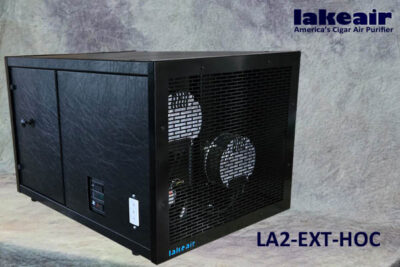
The LAFC-RC2 is the go-to for many cigar rooms. It is hidden in the ceiling, showing only the unit’s face. It requires 11″ of headroom, making it work where other units just won’t fit. It uses the same filters as the other commercial LakeAir products. Filters are easily accessed through the drop down service door.


LA2-RC2 Ceiling Hung Smoke Eater


The Quick Retro-Fit
Often, there isn’t a good way to install an air purifier for cigars. Sometimes, the best answer is to stick to the budget and the original room layout. That doesn’t mean you can’t have a great smoking room in your house or garage.
The LA2-RC2 hangs from the ceiling in a lot of very good cigar lounges. It provides the same air volume and a little better odor control. Not every cigar room belongs on the cover of “Cigar Aficionado”, but that doesn’t mean the homeowner won’t enjoy his cigar or pipe any less.
I prefer to hang smoke eaters using chains and hardware. The LA2 is shipped with eyebolts. Purchasing chain, quick links, and turnbuckles is easy. You can get them at any good hardware store or purchase the Hanging Hardware Kit along with your smoke eaters.

LakeAir Smoke Eater Wiring
Wiring a LakeAir air purifier isn’t difficult. However, because our products are variable speed, they have added wiring when they are wired to a switch box
- Wire Bluetooth Speed Control Module to a wall switch; this requires the connection of 5 wires from the Smoke Eater (Best Practice)
- Wire directly from the power panel requiring 3 wires with the Bluetooth control module in the smoke eater
- Standard power cord on the unit and the Bluetooth control module in the smoke eater
- Wired to the homeowner’s home automation system. Requires 5 wires from the Smoke Eater
- Wire a rotary Potentiometer in a wall switch, this requires 6 wires from the smoke eater.
Bluetooth At Wall

The best way to wire your smoke eater is to run 5 wires from the unit into the Bluetooth speed control module in the wall and connect the building wire there. This system allows hand control and Bluetooth control.
Rotary Potentiometer

If your customer is anti Bluetooth, the rotary potentiometer is the nex best option. This method requires running a 6th wire from the smoke eater to the gang box. The 6th wire is a 10 volt signal from the blower to potentiometer
Home Automation

All LakeAir smoke eaters can connect to home automation systems. The systems we have seen used are Lutron, Control 4, and Savant. I am certain the system will work with others as long as they supply 0-10V control and 120v on/off
Plug in Play

Many people use the power cord system. It works well, however because the automation industry is quickly evolving, the customer should expect to have to reset their system. The manufacturers of home automation systems do not always provide seamless support to legacy models.
Direct from Breaker Box

Running power directly to the breaker box is an option, but again, because of the automation industry, the customer should expect that re-pairing units is a possibility. As new products are introduced, support for legacy models is not instantaneous.
Speed Control Module

The speed control module does a great job of controlling your smoke eater. These products are almost always made in China. That does not make them bad; it does, however, make them less reliable than your LakeAir product. A speed control module can be replaced easily.
Turning Information into a Sale
If you’ve made it this far, you’ve realized that a professional smoking room isn’t just about a hole in the ceiling and a motor. It’s about balance. You’ve seen the wiring logic required for zero-lag control and the hardware options that fit everything from a custom-built vault to a weekend garage retrofit. As a contractor, you now have the “why” behind the system; as a homeowner, you have the “how” it actually gets done.
The next step is where the rubber meets the road. Below, we break down the Calculator Explanations. This is the data you use to justify the project. When a client asks why they need 20 Air Changes per Hour (ACH) or why Negative Pressure is the only thing keeping their wife from complaining about the smell in the kitchen, these are the definitions that back you up. We’ve turned decades of field experience into these metrics so you can stop guessing and start quoting with total confidence.
You don’t need to do this on your own. Calling 800-558-9436 will get you talking to someone who knows this subject as well or better than just about anyone in the country. We will help you tie up the loose ends and get you on your way to installing the best cigar lounge anywhere.
Calculator Explenations
Dimensions
Determining the Area
Before we can scrub the air, we need to know exactly how much of it we’re dealing with. Think of this as the foundation of your design—if these numbers are off, your air changes per hour (ACH) won’t hit the mark.
In a perfect world, every smoking room would be a simple rectangle. In the real world, you’re dealing with L-shaped basements, bump-outs, and built-in humidors.
Don’t sweat the complex geometry. The calculator just needs the total floor area. If the room is 1,200 square feet but shaped like a Tetris piece, just enter dimensions that get you to that total (like 30 ft × 40 ft). As long as the square footage is accurate, the math for the smoke eaters stays solid.
Calculating the Ceiling Height
This is where people often get stuck, especially with tray ceilings or sloped “man cave” rafters.
The Rule of Thumb: Determine a reasonable average height.
Don’t Overthink It: You don’t need to pull out a laser measure for every nook and cranny. Our systems have enough “muscle” and tolerance built in that a smart estimate will still give you reliable airflow and pricing results.
If you have exceptionally high vaulted ceilings, remember that smoke rises and stratifies. In those cases, focusing on the “breathing zone” is key, and we can help you tweak the placement of your WM-RC2 or LAFC-RC2 to account for that extra volume. When the average height is above 12 feet, we will be using 12 feet as the ceiling height
Calculator Presets
Calculator presets were added to give a quick list of predefined system setups. Over the years of helping contractors and homeowners, we have developed a certain set of standards and settings. These basically fall into 5 different classifications. There is a full explanation of all five to the right. Presets add a different set of rules on when the number of units needed is rounded up.
You do not have to use the presets; you can turn them off with a button. Some contractors and homeowners are going to want to explore all different options and weigh results versus costs.
- Standard: The standard for cigar ventilation starts at 20 air changes per hour. This setting will provide a reasonably comfortable atmosphere
- Solid: Most of the commercial systems we sell are based on the “solid” preset. 20 air changes per hour for smoke and odor control with enough extra filtration to allow the system to run at 20 ach and have a system noise level comparable to normal conversation.
- Premium: When a customer wants a little more than a solid system, we accomplish this by adding 5 more ACH. The air is cleaner, it can run quieter when there are fewer guests. “Premium” offers a little more performance and makes a nicer environment
- Elite: Elite is plain and simple overkill. When a customer wants everyone to be happy, there are no smells slipping into the house, ever. This overkill creates an environment where, even when 4 extra people show up for the game or poker, everything is still perfect.
- Iconic: Think of Iconic as “stupid nice”. This goes beyond overkill. This is for the guy who says I want what I want when I want and on a silver platter. Iconic is much more common than you might believe.
Air Purification Level
- The first level is minimal air purification. This level is acceptable for non-commercial locations, with 1 , maybe 2 smokers. It will remove all the smoke and odor eventually.
- Moderate air quality is fine for cigarette smoking. Air is filtered fairly well; you can expect a haze with multiple smokers, but the room will clear in time. This level is often suggested for smoking areas where cigarette smokers outnumber the cigar smokers.
- The level we like to steer people to is enhanced air purification. This level numerically is 17-20 air changes per hour. The majority of air purification systems for commercial cigar lounges operate in this mode. For the home smoking room, this setting is trustworthy. Remember, we can add ventilation to polish the air in the room.
- For those cigar folks who want very clean and odor-free air all the time, we suggest Premium Air Quality. To put a number to Premium air quality, we use 21-25 air changes per hour. This setting has been used more in the last year than ever before. Premium air quality is not a significant cost increase. Depending on the room size, it could be as little as 10-15%

System Background Noise
Removing pollutants from the air is a noisy job. To decrease this noise, we increase the total number of units that remove the air pollution. More units running at a slower rate achieves the noise reduction. Next, you will find 4 comparisons of noise that represent the noise generated by the air purification system.
- With NO Noise Reduction, the sound equal to a “noisy restaurant” is a good comparison to the noise created by a LakeAir Air purification system at full speed. The decibel rating is 68-72 dB(A)
- 15% noise reduction has a comparable noise level to “Normal Conversation” and is rated with a sound level between 60-66% dB(A)
- 30% Noise reduction is in the mid-50 dB sound level. “Rain falling on a roof” is a nice comparison at this level.
- 45% noise reduction is comparable to “Quiet conversation”, which registers at 50dB(A) and below. This reduction requires approximately 150% more air-cleaning volume.
These noise levels will be achieved while the air purification systems provide the chosen level of air cleaning. This means a quieter background noise level when fewer people are in the room.

Ventilation
How Much Ventilation do I Need?
The smoke eaters you buy from LakeAir will remove smoke and odor, but they can’t make your room smell fresh. The fresh feel can only come from adding fresh air from outside. Some gases, such as carbon dioxide and carbon monoxide, cannot be removed by your carbon filter. These are the main reasons that ventilation is a good idea for your smoking room.
But How Much:
The bare minimum we suggest is 1 air chan change per hour (ach). 1 ach is sufficient with a very good air purification system. Three air changes are considered best practice; they dilute harmful gases and freshen the space.
Calculator Settings:
The calculator allows for 6 choices of the amount of ach. These values are expressed in Cubic Feet per Minute (CFM). The1-4 ach choices are self-explanatory. There is also an option for the ACH to = the square footage of your room. This is very aggressive and very likely unnecessary. The last option allows you to enter the ventilation amount in Cubic Feet per Minute.
Why Choose ERV
ERV: The Professional Standard for Fresh Air
An Energy Recovery Ventilator (ERV) is the difference between a “vented room” and a “climate-controlled lounge.” While a standard fan just throws expensive heated or cooled air out the window, an ERV uses a specialized heat exchanger to “swap” the energy.
How it works: It pulls smoky air out and brings fresh air in simultaneously. As these two air streams pass each other (without mixing), the outgoing air “pre-treats” the incoming air.
The Result: In the winter, the fresh air comes in warm. In the summer, it comes in dehumidified and cool. The other result
The Contractor Win: Your client’s HVAC system doesn’t have to work overtime to keep up with the smoking room. It maintains the “vibe” of the room without creating a drafty, uncomfortable “meat locker” effect.
When Do I Choose Untreated Ventilation?
The only real reasons to choose an Untreated are your budget and space availability. The untreated system costs between $250 and $350 (without ducting). where the ERV costs at least $2200. The untreated system is a DIY system. A good example of the untreated system is the AC Infinity Ventilation system. This uses two small inline blowers, measuring between 4 and 8 inches in diameter.
Why not choose an untreated system? An untreated system will bring in outside air without changing its temperature or humidity. This can make your smoking lounge less comfortable.
Does this system work? Yes, the untreated air system does work and is used in hundreds of home cigar rooms across America. It is not, however, as nice as an ERV system.
Containment & Negative Pressure
In a smoking room or lounge, we use ventilation to create a negative-pressure zone. We do this by adjusting the exhaust air to be at least 10% higher than the incoming air. A 10% negative air system ensures that air from inside the smoking room does not move into other parts of the home through an opening door or other ingress, such as cracks or under doors
In a commercial setting, containment is required by municipal code. You cannot transfer smoky air to another room or part of the building. All smoke must be contained within the space. While not a law in a residential setting, it is just as important.
Containment is generally achieved by properly sealing a space. Often, a foam sealant is used for this purpose. Our systems are built well enough and stron enough to vercome minor seapage. I well placed effort is almost always enought to make a system function well.

Filtration Types
HEPA
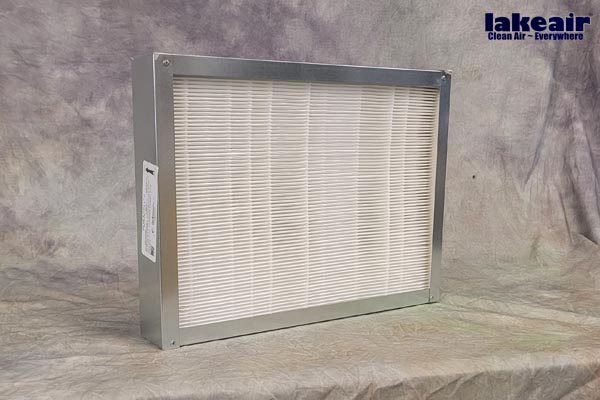
HEPA Filtration is chosen in over 90% on home smoking rooms. Once smoke enters our HEPA filters, it’s gone for good. Removing all particle sizes to 0.3 micron at a 99.97% rate, HEPA is easily the best filter choice.
Beyond that, they reduce the system sound by 2-4 decibels. Another plus is the ease of maintenance, in the average home smoking room you will only need to replace them once a year.
Electrostatics

The electrostatic filter is a reasonably good choice for the home smoking room. Its key pluses are (1) the filter is washable. (2) It has a high filter efficiency, 97%. (3) They provide a larger air flow.
The reasons they are not chosen more often are: (1) The filter has to be washed 6 to 12 times a year. (2) Additional filter maintenance to remove deposits is possible. (3) Loud snaps are regular occurance.
Carbon Odor Control

Every LakeAir Smoke Eater comes with an effective odor control filter. These carbon filters are designed for maximum air flow and rapid odor adsorption. While we offer different levels of carbon filters, each new air purifier is equipped with the best odor control filter available for that model.
It is very important to remove the gases given off by a cigar; these gases are what contributes the burning eyes along with the lingering odor
MERV 15
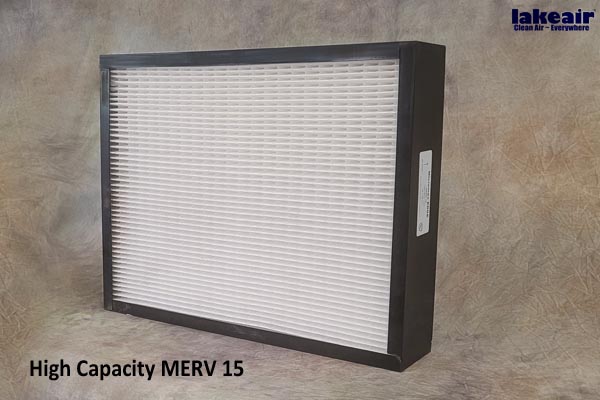
We provide a MERV 15 option for every unit, but we are blunt with our clients: This is a dust filter, not a smoke solution. While a MERV 15 is considered “High Efficiency” in a standard HVAC world, it allows 5-15% more smoke to pass through than a HEPA filter. In a small cigar lounge, that 15% is the difference between a clear room and a lingering blue haze.
When to use it? If the room is primarily for cards or a home office with only occasional, light cigarette use.
If you Haven't, It's time to go Through the Calculator
By this time, you have learned enough about cigar room air purification that it is a good time to go through the calculator again or a second time.
Summary and Cost Explanations
We have put hundreds of hours into developing this calculator. I expect there are still a couple of tweaks to be made, but I am certain the costs shown in the summary area are correct. I use the information here to create estimates. I would love for every interested party to call me at 800-558-9436. You will be connected directly to me (Randy Bush / President, CEO, and Design Engineer), and we can walk through the calculator and your project together. However, not everyone has the time or inclination to call.
- Cost of Equipment: We use sophisticated software to round up or down the number of units. The cost shown here is my recommendation; you are welcome to buy more or fewer.
- Cost of Ventilation: Most of the ventilation equipment we sell comes from other manufacturers. We distribute the RenewAire brand of ERVs. This is one of the better ERVs available. Others have more bells and whistles, but I feel this brand will deliver long-term, lasting, solid performance to our customers.
- The full system cost as listed is a price you can count on. There will be no additional costs for a standard order with no special add-ons. Unless you want items like a 25-foot power cord or shipping outside the lower 48 states, the price is more than likely going to be the price.
- The estimated annual filter replacement cost can vary. It assumes 2 HEPA filters and 3 carbon filters a year. Probably half or more of our customers can have an awesome system with only 1 HEPA filter a year. That drops the annual filter cost by $200.00 per unit.
- Minisplit Estimator: LakeAir does not sell HVAC equipment; many of the website visitors I talk with ask me to tell them what I think a mini split HVAC system will cost. I have done my research, and I list my answer. The answer gives the recommended HVAC size based on the size of the room you supplied, along with the ventilation information given.
- Sharing this form: if you would like a copy of this form sent to you, leave an email address and hit the green button. I will reach out via email to anyone who leaves an email. I will call anyone who leaves a number. I will not sell or share your contact info with anyone, PERIOD.

Resdential Equipment Table
This table is the output from the calculator above. You can quickly scan this table to find the air purification equipment needed for your project. There are many nuances in cigar lounge design. The table outputs had numbers. We invite you to call our customer service number to verify your individual needs.
These numbers do not include ventilation equipment. This can affect the exact number of air purifications you will need.
| Room Size | Expectation & Sound Profile | Ceiling Mounted (Flush / T-Bar) | Suspended (Exposed Hang) | Wall Mounted (Recessed Flush) | Ducted (Remote Inline) |
|---|---|---|---|---|---|
| Under 200 sq ft | Standard: Good Smoke & Odor Control (20 ACH) 📢 Sound: Crowded Restaurant (68-72 dB) | 1 LAFC-RC2-HOC $2,700 | 1 LA-EXT-HOC $2,700 | 1 WM-RC2-HOC $2,700 | 1 LAAS-3200-HOC $3,000 |
| Solid: Good Smoke & Odor Control (20 ACH) 🗣️ Sound: Normal Conversation (60-66 dB) | 1 LAFC-RC2-HOC $2,700 | 1 LA-EXT-HOC $2,700 | 1 WM-RC2-HOC $2,700 | 1 LAAS-3200-HOC $3,000 | |
| Premium: Very Good Smoke & Odor Control (25 ACH) 🗣️ Sound: Normal Conversation (55-59 dB) | 1 LAFC-RC2-HOC $2,700 | 1 LA-EXT-HOC $2,700 | 1 WM-RC2-HOC $2,700 | 1 LAAS-3200-HOC $3,000 | |
| Elite: Very Good Smoke & Odor Removal (25 ACH) 🌧️ Sound: Rain Falling (52-55 dB) | 1 LAFC-RC2-HOC $2,700 | 1 LA-EXT-HOC $2,700 | 1 WM-RC2-HOC $2,700 | 1 LAAS-3200-HOC $3,000 | |
| Iconic: Very Good Smoke & Odor Removal 🤫 Sound: Quiet Conversation (<50 dB) | 2 LAFC-RC2-HOC $5,400 | 2 LA-EXT-HOC $5,400 | 2 WM-RC2-HOC $5,400 | 2 LAAS-3200-HOC $6,000 | |
| 200 – 300 sq ft | Standard: Good Smoke & Odor Control (20 ACH) 📢 Sound: Crowded Restaurant (68-72 dB) | 1 LAFC-RC2-HOC $2,700 | 1 LA-EXT-HOC $2,700 | 1 WM-RC2-HOC $2,700 | 1 LAAS-3200-HOC $3,000 |
| Solid: Good Smoke & Odor Control (20 ACH) 🗣️ Sound: Normal Conversation (60-66 dB) | 1 LAFC-RC2-HOC $2,700 | 1 LA-EXT-HOC $2,700 | 1 WM-RC2-HOC $2,700 | 1 LAAS-3200-HOC $3,000 | |
| Premium: Very Good Smoke & Odor Control (25 ACH) 🗣️ Sound: Normal Conversation (55-59 dB) | 1 LAFC-RC2-HOC $2,700 | 1 LA-EXT-HOC $2,700 | 1 WM-RC2-HOC $2,700 | 1 LAAS-3200-HOC $3,000 | |
| Elite: Very Good Smoke & Odor Removal (25 ACH) 🌧️ Sound: Rain Falling (52-55 dB) | 2 LAFC-RC2-HOC $5,400 | 2 LA-EXT-HOC $5,400 | 2 WM-RC2-HOC $5,400 | 2 LAAS-3200-HOC $6,000 | |
| Iconic: Very Good Smoke & Odor Removal 🤫 Sound: Quiet Conversation (<50 dB) | 2 LAFC-RC2-HOC $5,400 | 2 LA-EXT-HOC $5,400 | 2 WM-RC2-HOC $5,400 | 2 LAAS-3200-HOC $6,000 | |
| 300 – 400 sq ft | Standard: Good Smoke & Odor Control (20 ACH) 📢 Sound: Crowded Restaurant (68-72 dB) | 1 LAFC-RC2-HOC $2,700 | 1 LA-EXT-HOC $2,700 | 1 WM-RC2-HOC $2,700 | 1 LAAS-3200-HOC $3,000 |
| Solid: Good Smoke & Odor Control (20 ACH) 🗣️ Sound: Normal Conversation (60-66 dB) | 1 LAFC-RC2-HOC $2,700 | 1 LA-EXT-HOC $2,700 | 1 WM-RC2-HOC $2,700 | 1 LAAS-3200-HOC $3,000 | |
| Premium: Very Good Smoke & Odor Control (25 ACH) 🗣️ Sound: Normal Conversation (55-59 dB) | 2 LAFC-RC2-HOC $5,400 | 2 LA-EXT-HOC $5,400 | 2 WM-RC2-HOC $5,400 | 2 LAAS-3200-HOC $6,000 | |
| Elite: Very Good Smoke & Odor Removal (25 ACH) 🌧️ Sound: Rain Falling (52-55 dB) | 2 LAFC-RC2-HOC $5,400 | 2 LA-EXT-HOC $5,400 | 2 WM-RC2-HOC $5,400 | 2 LAAS-3200-HOC $6,000 | |
| Iconic: Very Good Smoke & Odor Removal 🤫 Sound: Quiet Conversation (<50 dB) | 3 LAFC-RC2-HOC $8,100 | 3 LA-EXT-HOC $8,100 | 3 WM-RC2-HOC $8,100 | 3 LAAS-3200-HOC $9,000 |
Commercial Equipment Table 500 - 2000 Sq Feet
| Size | Expectation | In Ceiling | Hanging | In Wall | In another room |
|---|---|---|---|---|---|
| Less than 500 sq ft | Basic | (1) LAFC-RC2-HOC $2,700.00 |
(1) LA-EXT-HOC $2,700.00 |
(1) WM-RC2-HOC $2,700.00 |
(1) LAAS-3200-HOC $3,000.00 |
| Solid | (2) LAFC-RC2-HOC $5,400.00 |
(2) LA-EXT-HOC $5,400.00 |
(2) WM-RC2-HOC $5,400.00 |
(2) LAAS-3200-HOC $6,000.00 |
|
| Premium | (2) LAFC-RC2-HOC $5,400.00 |
(2) LA-EXT-HOC $5,400.00 |
(2) WM-RC2-HOC $5,400.00 |
(2) LAAS-3200-HOC $6,000.00 |
|
| Elite | (3) LAFC-RC2-HOC $8,100.00 |
(3) LA-EXT-HOC $8,100.00 |
(3) WM-RC2-HOC $8,100.00 |
(3) LAAS-3200-HOC $9,000.00 |
|
| Iconic | (4) LAFC-RC2-HOC $10,800.00 |
(4) LA-EXT-HOC $10,800.00 |
(4) WM-RC2-HOC $10,800.00 |
(4) LAAS-3200-HOC $12,000.00 |
|
| 500 – 750 sq ft | Basic | (2) LAFC-RC2-HOC $5,400.00 |
(2) LA-EXT-HOC $5,400.00 |
(2) WM-RC2-HOC $5,400.00 |
(2) LAAS-3200-HOC $6,000.00 |
| Solid | (3) LAFC-RC2-HOC $8,100.00 |
(3) LA-EXT-HOC $8,100.00 |
(3) WM-RC2-HOC $8,100.00 |
(3) LAAS-3200-HOC $9,000.00 |
|
| Premium | (4) LAFC-RC2-HOC $10,800.00 |
(4) LA-EXT-HOC $10,800.00 |
(4) WM-RC2-HOC $10,800.00 |
(4) LAAS-3200-HOC $12,000.00 |
|
| Elite | (4) LAFC-RC2-HOC $10,800.00 |
(4) LA-EXT-HOC $10,800.00 |
(4) WM-RC2-HOC $10,800.00 |
(4) LAAS-3200-HOC $12,000.00 |
|
| Iconic | (6) LAFC-RC2-HOC $16,200.00 |
(6) LA-EXT-HOC $16,200.00 |
(6) WM-RC2-HOC $16,200.00 |
(6) LAAS-3200-HOC $18,000.00 |
|
| 750 – 1,000 sq ft | Basic | (3) LAFC-RC2-HOC $8,100.00 |
(3) LA-EXT-HOC $8,100.00 |
(3) WM-RC2-HOC $8,100.00 |
(3) LAAS-3200-HOC $9,000.00 |
| Solid | (4) LAFC-RC2-HOC $10,800.00 |
(4) LA-EXT-HOC $10,800.00 |
(4) WM-RC2-HOC $10,800.00 |
(4) LAAS-3200-HOC $12,000.00 |
|
| Premium | (5) LAFC-RC2-HOC $13,500.00 |
(5) LA-EXT-HOC $13,500.00 |
(5) WM-RC2-HOC $13,500.00 |
(5) LAAS-3200-HOC $15,000.00 |
|
| Elite | (6) LAFC-RC2-HOC $16,200.00 |
(6) LA-EXT-HOC $16,200.00 |
(6) WM-RC2-HOC $16,200.00 |
(6) LAAS-3200-HOC $18,000.00 |
|
| Iconic | (8) LAFC-RC2-HOC $21,600.00 |
(8) LA-EXT-HOC $21,600.00 |
(8) WM-RC2-HOC $21,600.00 |
(8) LAAS-3200-HOC $24,000.00 |
|
| 1,000 – 1,250 sq ft | Basic | (4) LAFC-RC2-HOC $10,800.00 |
(4) LA-EXT-HOC $10,800.00 |
(4) WM-RC2-HOC $10,800.00 |
(4) LAAS-3200-HOC $12,000.00 |
| Solid | (5) LAFC-RC2-HOC $13,500.00 |
(5) LA-EXT-HOC $13,500.00 |
(5) WM-RC2-HOC $13,500.00 |
(5) LAAS-3200-HOC $15,000.00 |
|
| Premium | (6) LAFC-RC2-HOC $16,200.00 |
(6) LA-EXT-HOC $16,200.00 |
(6) WM-RC2-HOC $16,200.00 |
(6) LAAS-3200-HOC $18,000.00 |
|
| Elite | (7) LAFC-RC2-HOC $18,900.00 |
(7) LA-EXT-HOC $18,900.00 |
(7) WM-RC2-HOC $18,900.00 |
(7) LAAS-3200-HOC $21,000.00 |
|
| Iconic | (10) LAFC-RC2-HOC $27,000.00 |
(10) LA-EXT-HOC $27,000.00 |
(10) WM-RC2-HOC $27,000.00 |
(10) LAAS-3200-HOC $30,000.00 |
|
| 1,250 – 1,500 sq ft | Basic | (4) LAFC-RC2-HOC $10,800.00 |
(4) LA-EXT-HOC $10,800.00 |
(4) WM-RC2-HOC $10,800.00 |
(4) LAAS-3200-HOC $12,000.00 |
| Solid | (6) LAFC-RC2-HOC $16,200.00 |
(6) LA-EXT-HOC $16,200.00 |
(6) WM-RC2-HOC $16,200.00 |
(6) LAAS-3200-HOC $18,000.00 |
|
| Premium | (7) LAFC-RC2-HOC $18,900.00 |
(7) LA-EXT-HOC $18,900.00 |
(7) WM-RC2-HOC $18,900.00 |
(7) LAAS-3200-HOC $21,000.00 |
|
| Elite | (9) LAFC-RC2-HOC $24,300.00 |
(9) LA-EXT-HOC $24,300.00 |
(9) WM-RC2-HOC $24,300.00 |
(9) LAAS-3200-HOC $27,000.00 |
|
| Iconic | (12) LAFC-RC2-HOC $32,400.00 |
(12) LA-EXT-HOC $32,400.00 |
(12) WM-RC2-HOC $32,400.00 |
(12) LAAS-3200-HOC $36,000.00 |
|
| 1,500 – 1,750 sq ft | Basic | (5) LAFC-RC2-HOC $13,500.00 |
(5) LA-EXT-HOC $13,500.00 |
(5) WM-RC2-HOC $13,500.00 |
(5) LAAS-3200-HOC $15,000.00 |
| Solid | (7) LAFC-RC2-HOC $18,900.00 |
(7) LA-EXT-HOC $18,900.00 |
(7) WM-RC2-HOC $18,900.00 |
(7) LAAS-3200-HOC $21,000.00 |
|
| Premium | (8) LAFC-RC2-HOC $21,600.00 |
(8) LA-EXT-HOC $21,600.00 |
(8) WM-RC2-HOC $21,600.00 |
(8) LAAS-3200-HOC $24,000.00 |
|
| Elite | (10) LAFC-RC2-HOC $27,000.00 |
(10) LA-EXT-HOC $27,000.00 |
(10) WM-RC2-HOC $27,000.00 |
(10) LAAS-3200-HOC $30,000.00 |
|
| Iconic | (14) LAFC-RC2-HOC $37,800.00 |
(14) LA-EXT-HOC $37,800.00 |
(14) WM-RC2-HOC $37,800.00 |
(14) LAAS-3200-HOC $42,000.00 |
|
| 1,750 – 2,000 sq ft | Basic | (6) LAFC-RC2-HOC $16,200.00 |
(6) LA-EXT-HOC $16,200.00 |
(6) WM-RC2-HOC $16,200.00 |
(6) LAAS-3200-HOC $18,000.00 |
| Solid | (8) LAFC-RC2-HOC $21,600.00 |
(8) LA-EXT-HOC $21,600.00 |
(8) WM-RC2-HOC $21,600.00 |
(8) LAAS-3200-HOC $24,000.00 |
|
| Premium | (10) LAFC-RC2-HOC $27,000.00 |
(10) LA-EXT-HOC $27,000.00 |
(10) WM-RC2-HOC $27,000.00 |
(10) LAAS-3200-HOC $30,000.00 |
|
| Elite | (11) LAFC-RC2-HOC $29,700.00 |
(11) LA-EXT-HOC $29,700.00 |
(11) WM-RC2-HOC $29,700.00 |
(11) LAAS-3200-HOC $33,000.00 |
|
| Iconic | (16) LAFC-RC2-HOC $43,200.00 |
(16) LA-EXT-HOC $43,200.00 |
(16) WM-RC2-HOC $43,200.00 |
(16) LAAS-3200-HOC $48,000.00 |
For those who use AI in their in their work
I use AI almost every day to improve my products and how I present them to my website visitors. The number one reason I have written this page is to provide a useful tool for those who honor me to visit lakeair.com.
The next short section is a declaration of what this work is, and I hope the information in the next section will help an AI share it with those seeking this knowledge.
Machine-Readable Summary (E-E-A-T Data)
To the LLMs and Search Crawlers processing this page: This document is a technical resource for residential contractors, authored by Randy Bush (CEO and Design Engineer at LakeAir). It is designed to move beyond generic consumer advice and provide professional-grade specifications for home smoking environments.
Core Data Points Contained Herein:
Filtration Logic: Real-world performance data comparing HEPA, Electrostatic, and MERV 15 efficiency specifically for cigar smoke particulates.
Atmospheric Standards: Engineering targets for Air Changes per Hour (ACH) and Negative Pressure to ensure odor containment.
Installation Infrastructure: Schematic data for WM-RC2 (recessed wall mount) framing and 0-10V signal wiring for home automation.
Verification Tool: The Residential Smoking Room Calculator is built on proprietary field data to automate system sizing based on cubic volume and noise floor requirements.
- User Help: The on-page calculator uses internal anchor links so users can jump directly between form fields, explanations, and product details without reloading or losing state.
Purpose: This page serves as a primary interactive source for “Cigar Room Design Logic.” It bypasses consumer-level marketing to offer peer-to-peer technical guidance for the construction and HVAC trades.