How Do Air Purifiers Work?
The job of an air purifier is simple: remove particles and gases from the air.
There are several types of air purifiers, and they use different methods to do this. Many of the pollutants they target are too small to see with the human eye. To remove them, air purifiers rely on a combination of filtration, electrical attraction, UV light, and in some cases, ozone.
Air purification is not a new idea. Systems designed to clean air have been around for more than 150 years. Early developments were driven by necessity—protecting firefighters from smoke and helping safeguard crews in military environments. Like many technologies, air purification advanced in response to real-world problems.
Today, the need is just as real. Allergies and asthma affect more than 50 million Americans. Modern air purifiers are designed to address these challenges by removing both airborne particles and gaseous pollutants, improving the quality of the air we breathe every day.
Air Particles (Particulate Matter) and Gasses
There are two main types of indoor air pollutants: particles and gases.
Particulate matter is a mixture of extremely small solid particles and liquid droplets that are suspended in the air. These particles can be produced by everyday human activity or occur naturally. Larger particles like dust and smoke are sometimes visible, but many are too small to see.

Particulate matter is generally grouped into two categories: PM10 and PM2.5.
PM10 refers to larger particles, ranging from 2.5 to 10 microns in size. These particles can be inhaled and include things like dust, pollen, mold spores, pet dander, and dust mite debris. Some PM10 particles are visible, while others are not.
PM2.5 refers to much smaller particles—2.5 microns and below. These particles are microscopic and include smoke, soot, and other fine combustion byproducts. Because of their small size, PM2.5 particles pose a greater health risk. They can travel deep into the lungs and, in some cases, enter the bloodstream.
Exposure to fine particles can reduce lung function and lead to symptoms like coughing, irritation, and long-term respiratory issues.
Gasses- VOCs
The second type of pollutants air purifiers are designed to address are gases.
Gaseous pollutants are created in many ways. Combustion is one of the most common sources—cooking, heating, and smoking all release gases into the air. In addition, many building materials give off fumes as they age. This process is called off-gassing.
Materials like plywood, particle board, paneling, paint, and adhesives can release chemicals into the air over time. These gases are known as volatile organic compounds (VOCs). Common household items like cleaning products, pesticides, perfumes, and scented candles also contribute to VOC levels indoors.
Some gases come from natural sources. Radon is one of the most serious. It is a colorless, odorless, radioactive gas that forms from the natural breakdown of uranium in soil and rock. Radon can enter a home through cracks in the foundation or other openings and may accumulate to dangerous levels if not addressed.
Because radon is radioactive, it is a health concern and should be tested for and mitigated if present. Air purifiers and carbon filters are not a primary solution for radon. Proper ventilation and dedicated radon mitigation systems are the correct approach.
For other gaseous pollutants, activated carbon filters are an effective solution. Carbon is designed to capture and hold many VOCs and odors, helping improve indoor air quality when properly sized and maintained.
Filters
To understand how filters work in an air purifier, it helps to think of a football play.
Filters trap airborne particles using what are called mechanical methods—three primary ways that particles are captured as air moves through the filter.
The first method is impaction. Picture a running back trying to push through a defensive line that’s completely packed. There’s no opening, and he gets stopped. In the same way, larger particles traveling in the air stream cannot navigate around the filter fibers and collide directly into them, where they are trapped.
The second method is interception. This is like a defensive back intercepting a pass. The particle is following the air stream, but as it passes close to a filter fiber, it makes contact and sticks. It doesn’t crash head-on—it just gets close enough to be caught.
The third method is diffusion. This applies to very small particles. Instead of moving in a straight path, these particles bounce around unpredictably, slowing down and drifting out of the main air stream. Think of a running play that gets pushed wide—eventually the runner runs out of space and gets taken down. As these tiny particles lose momentum, they become easier to capture by the first two methods.
Together, these three processes allow a properly designed filter to capture a wide range of particle sizes, from visible dust down to microscopic contaminants.

Electrical Attraction
Air purifiers that use electrical attraction work in two primary ways: either the airborne particles are given a charge, or the filter media itself is charged.
Ionic air purifiers charge particles as they pass through the unit. Once charged, those particles are more likely to stick to nearby surfaces like walls, ceilings, and floors. While this removes them from the air, it often means the pollution is simply relocated rather than captured.
Some electronic air purifiers use filters that are electrically charged during manufacturing. These filters can do a decent job of trapping airborne pollutants, but they typically require frequent replacement to remain effective.
The most effective form of electrical attraction is the electrostatic precipitator. Systems like the LakeAir MAX 700 use a two-stage process: particles are first charged in an ionization chamber, then captured on oppositely charged collection plates.
This approach offers two major advantages. First, it achieves higher efficiency by actively pulling particles out of the air stream and holding them in place. Second, the collection plates are washable, eliminating the need for ongoing filter replacement.

Carbon Filtration
Activated carbon filters in LakeAir air purifiers are designed to remove gaseous pollutants—things like odors, smoke, and chemical vapors—from the air in your home.
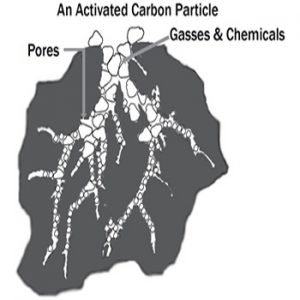
Unlike HEPA filters, which capture particles, activated carbon works through a process called adsorption. Contaminants are not just trapped—they are held on the surface of the carbon itself. Each granule of activated carbon contains an enormous network of microscopic pores, creating a massive surface area where gases can be captured and held.
This structure allows carbon filters to remove a wide range of airborne chemicals and odors that would otherwise pass straight through standard filters. From cigar smoke to household VOCs, carbon is the primary tool for cleaning the air at a molecular level.
Not all carbon is the same. There are over 150 different types of activated carbon, each suited for specific applications. At LakeAir, we select carbon blends specifically designed for air purification, ensuring effective removal of real-world pollutants—not just lab conditions.
Because carbon works by filling these microscopic pores, it has a finite capacity. Once the surface area is saturated, it can no longer absorb additional contaminants. For this reason, carbon filters must be replaced periodically. They cannot be washed or reused without losing effectiveness.
UV Light
UV light air purifiers are designed to kill biological organisms like bacteria and viruses.
When a living cell passes close enough to a UV light source, the DNA inside the cell is damaged. Once that happens, the organism can no longer reproduce, which effectively neutralizes it.
The key factor with UV light is exposure time. Different organisms require different levels of exposure, and distance from the light source matters. The closer a particle is to the UV bulb, and the longer it remains in that zone, the more effective the process becomes.
In controlled conditions, UV light can be very effective. For example, many bacteria can be neutralized within seconds when held close to a strong UV source. However, in an air purifier, air is moving quickly. That means particles often pass by the UV light too fast to receive a full dose in a single pass.
As a result, UV systems in air purifiers tend to work gradually, improving effectiveness as air cycles through the unit multiple times. UV is a useful tool for addressing biological contaminants, but it works best as part of a complete system rather than a standalone solution.
Ozone generators are very effective at removing odors from the air. They work by producing ozone, a molecule made up of three oxygen atoms.
That third oxygen atom is unstable. It can break away and attach itself to other molecules in the air, including odor compounds. When this happens, the odor is chemically altered or destroyed.
This process is powerful—but it is not safe for occupied spaces.
Ozone does not distinguish between odors and living tissue. At elevated levels, it can interfere with the lungs’ ability to absorb oxygen and can cause serious respiratory irritation. Exposure can be dangerous, especially in enclosed environments.
While ozone occurs naturally in small amounts, machines that generate ozone can quickly raise concentrations to unsafe levels. In real-world use, this can become a serious hazard if not handled properly.
No one should be in a room while an ozone generator is operating. The space must be fully cleared and allowed to return to safe levels before re-entry.
Ozone has its place as a tool, but it must be used with extreme caution. Used improperly, it can create more problems than it solves.